From Shattered to Whole

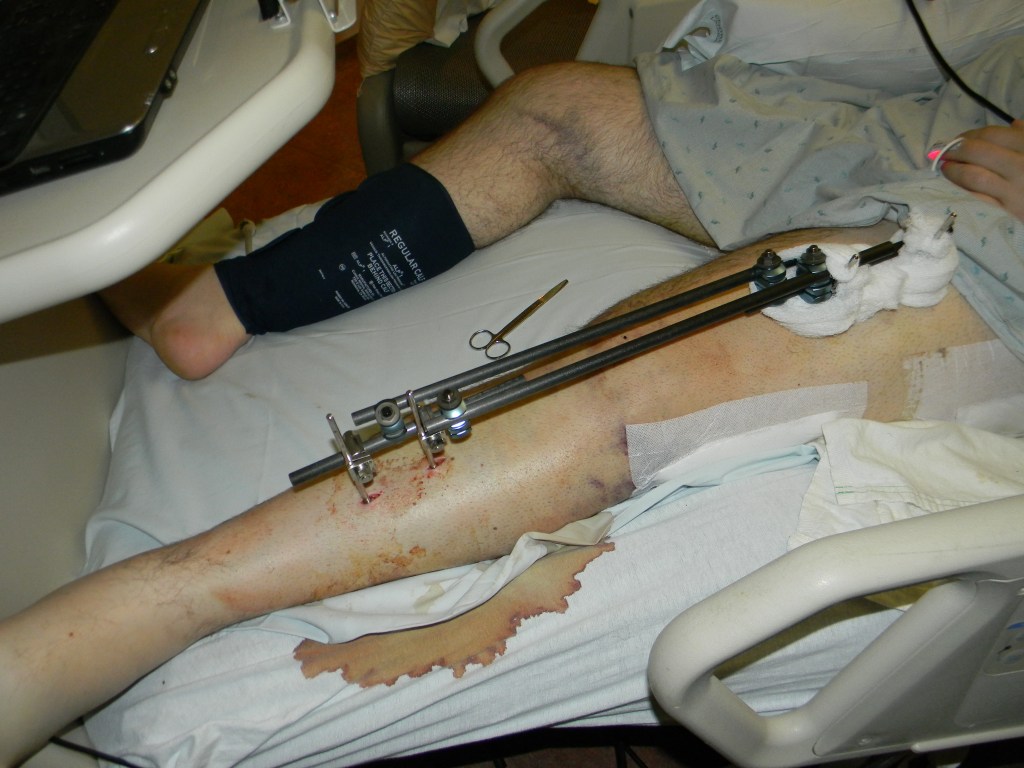
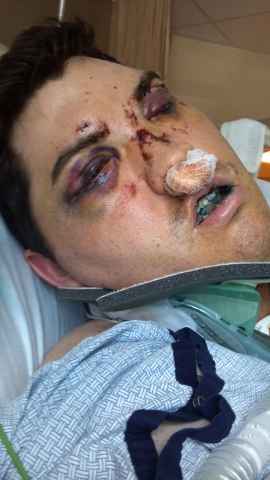
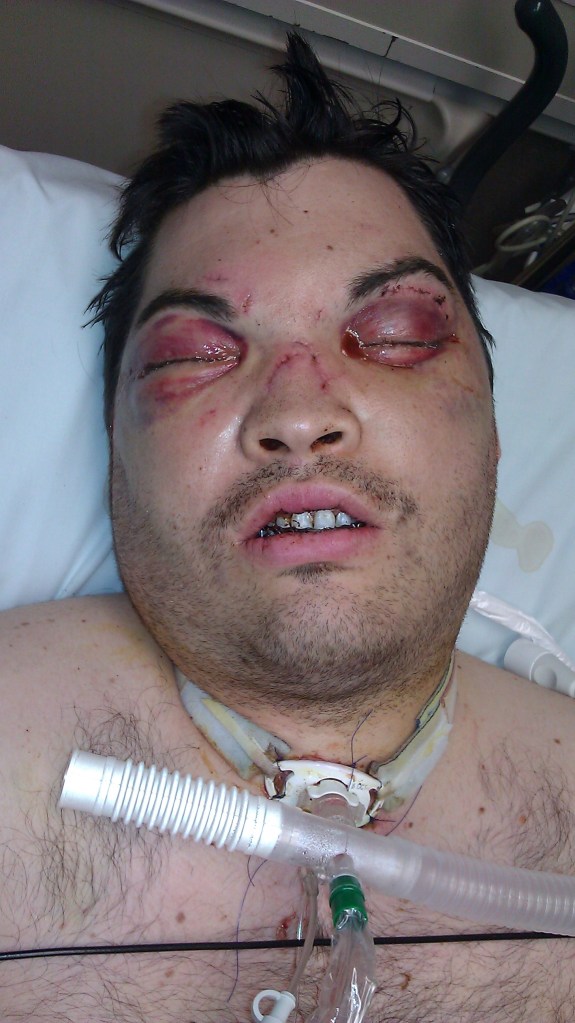
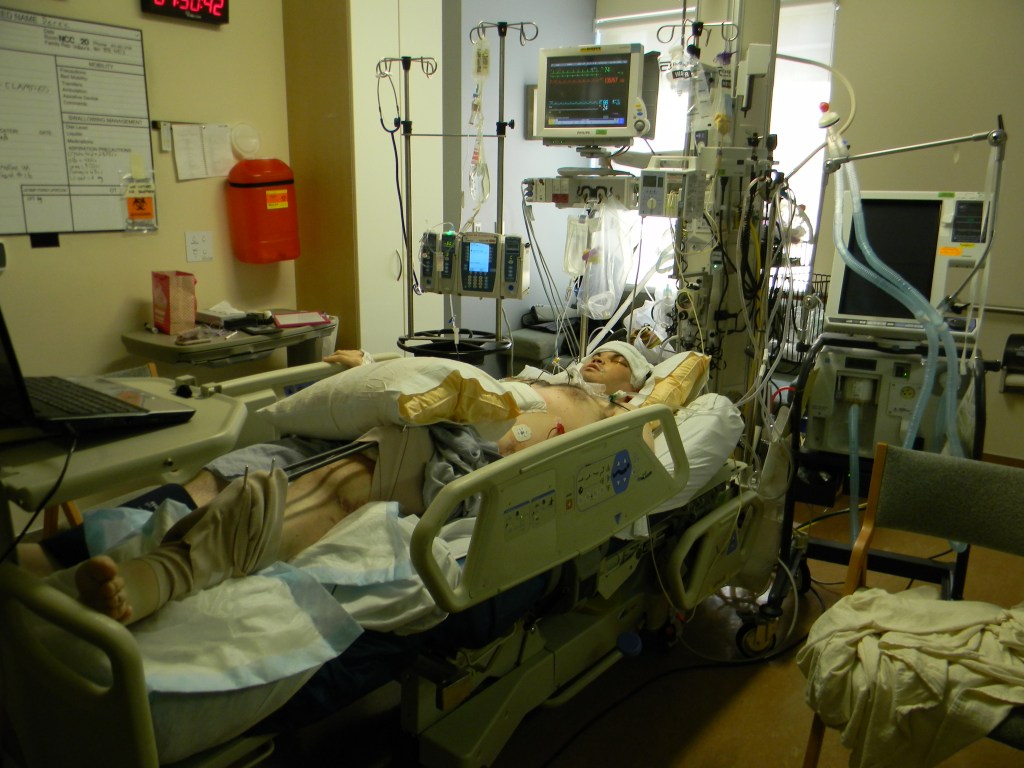
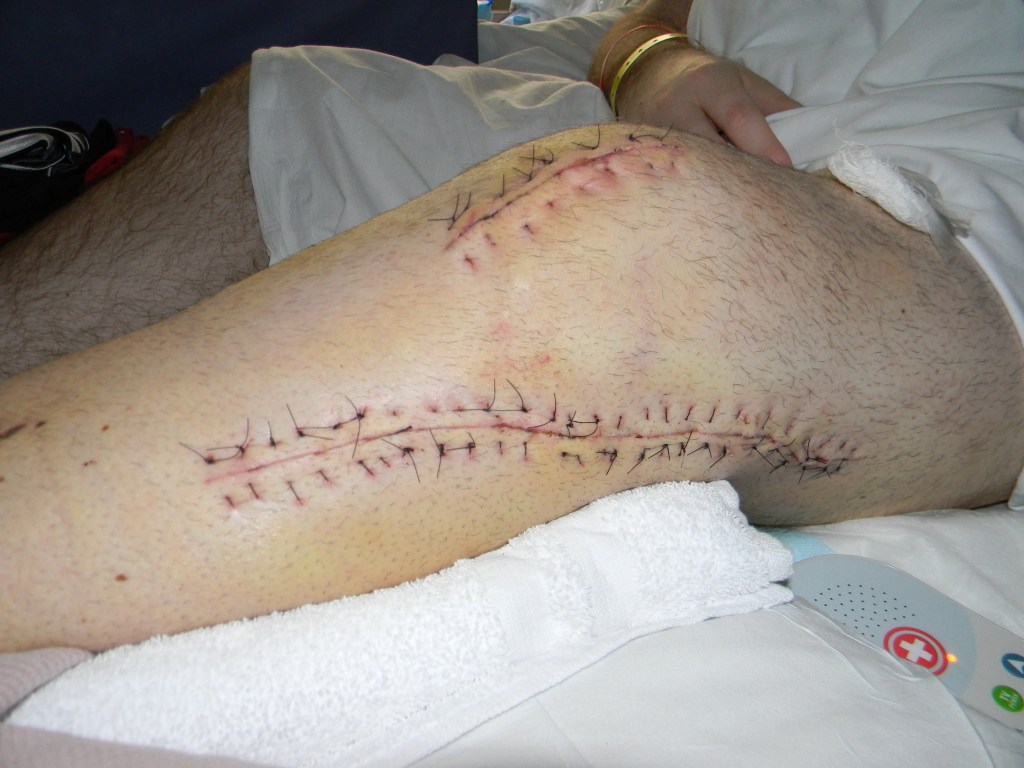
In July of 2012, my husband Derek was in a severe car accident with his boss as they came home from a business trip at night. They came over a hill and rear-ended a truck that was having mechanical issues, going very slowly on the freeaway, and smoking out the back obscuring it’s lights in the darkness. Derek shattered nearly every bone in his face, broke his femur in two places, broke his kneecap, and shattered the top of his tibia. He had five extensive surgeries over many hours during that first month in the hospital, including two surgeries to reconstruct his leg, two surgeries to reconstruct his face, and one brain surgery. He couldn’t talk because he had a trach and his jaw was wired shut. He couldn’t see because his eyes were swollen shut.
They placed a rod in his femur, put flexible sutures in his kneecap, and a scaffolding of hardware in his tibia. He wasn’t allowed to bear weight at all on that leg for months afterward and had to be in a wheelchair most of the time. They put extensive hardware all over in his face to piece it back together, including mesh across his forehead, in his eye sockets to hold up his eyes, plates to hold his eye sockets together, and various plates in his midface to hold things together. He still has some nerve damage to his eye (which has improved with time), as well as a pupil that doesn’t respond well to light.
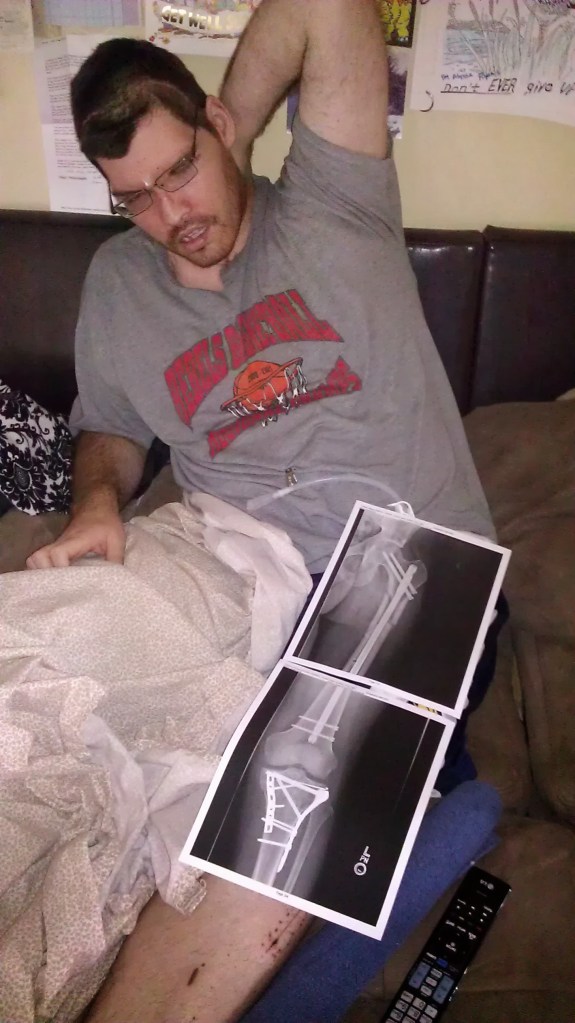
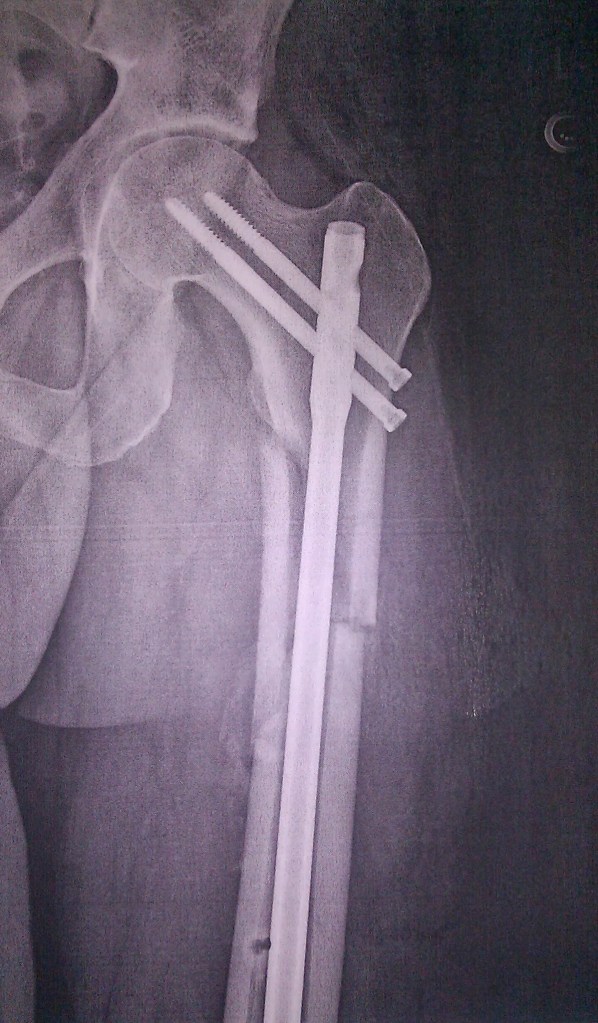
X-ray image of the rod and pins in Derek’s femur. 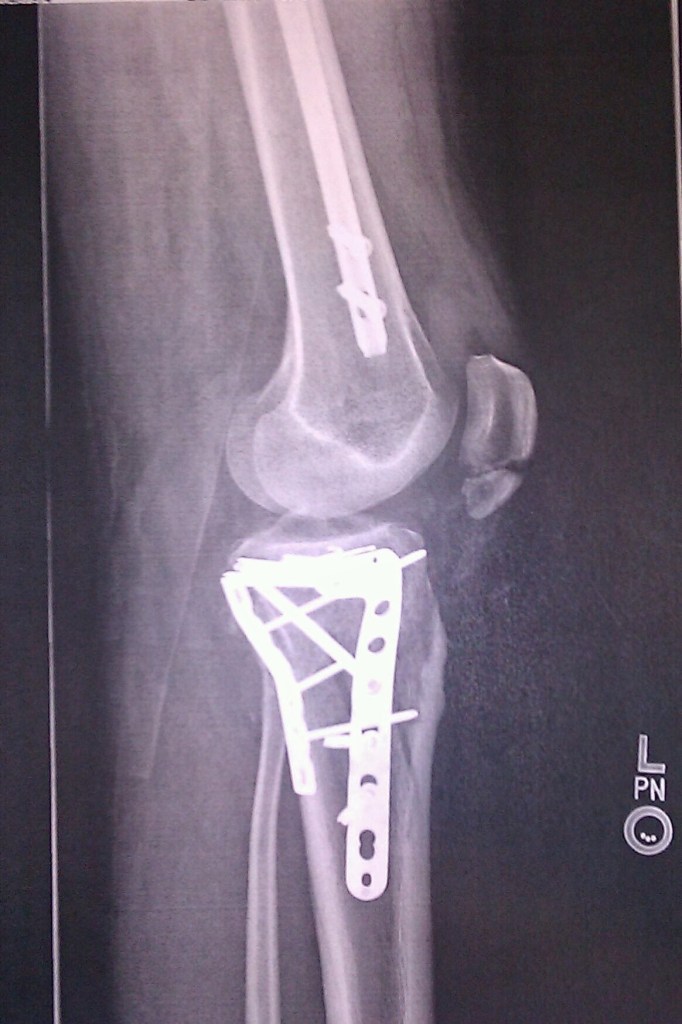
An X-ray showing the plates and pins in Derek’s tibia, as well as a nice shot of his kneecap snapped into two pieces. 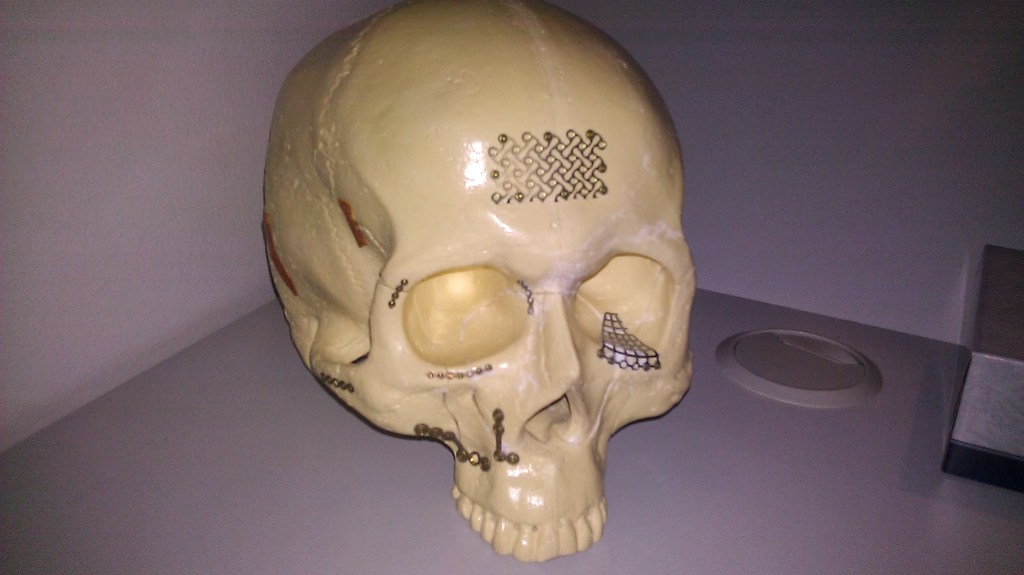
An example that was in the doctor’s office showing the types of mesh and plates that were put into Derek’s face. 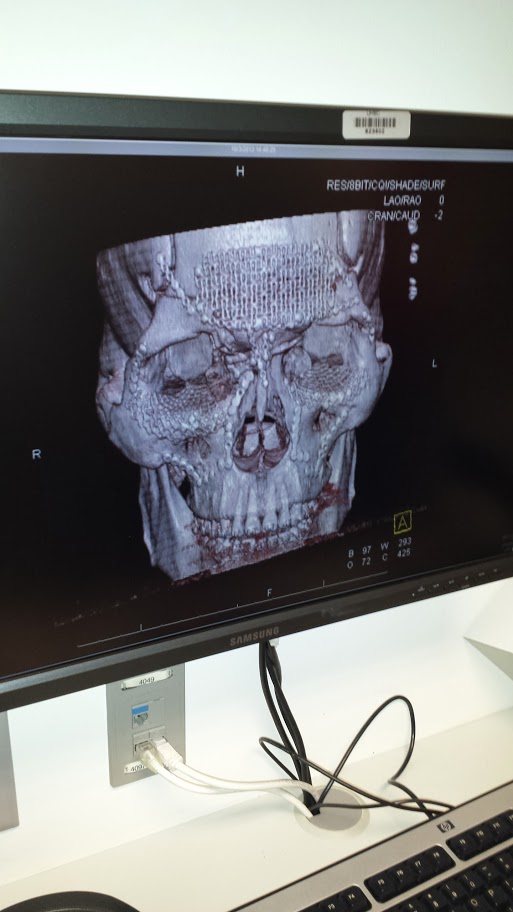
An MRI image of the hardware in Derek’s face. You can see the plates in his cheeks, plates around his eye sockets, and mesh across his forehead and in his eye sockets.
I took family leave from my job while he was in the hospital, but when he was finally discharged, I had to quit. He needed round the clock care. He had debilitating migraines for months. I took him to the ER in December of 2012 when I couldn’t manage his pain. The doctors in the ER didn’t seem concerned because of his history. They gave him an IV to hydrate him, a cocktail of drugs, and sent him home. He lived on our couch.

I kept trying to take care of him. I took him to physical therapy appointments, filled prescriptions, took him to follow up doctor appointments, and communicated with insurance adjusters, doctors, our case manager, and our lawyer. Derek needed braces to position his teeth correctly so that doctors could re-break his jaw and position his face better. The first time they’d put him back together like a thousand piece puzzle they had been more concerned with reconstruction and saving his life than they’d been with how things looked.
Now that he had healed enough they needed to put things back where they went. If they didn’t, he would continue to have problems biting and chewing. He would be more likely to keep having headaches. Repositioning his upper jaw would also help make him look normal again. He needed to wear the braces for two years to position his teeth in the right place. We were so disappointed.
I constantly tried to find ways to alleviate Derek’s pain. I bought books and massage tools. We made plans to go to his brother’s wedding, but Derek wasn’t doing so well. He was still having migraines that left him incapacitated for hours, and they were getting worse. In July of 2013 after a week-long series of back to back migraines that left him curled up and incapacitated, I took him back to the ER. This time, unlike the time before, the doctors CT scanned him. They kept asking if he had injured himself. We insisted that the only injury he’d had was the one a year before. He hadn’t had an opportunity to injure himself. He’d basically been sitting on a couch since then.
The doctors were really worried. They told Derek he looked better than he should based on his scan. He had air in his head, which didn’t sound good. After a round of medication and an IV he felt much better and wanted to go home, but this time the doctors wouldn’t let him leave. They sent him by ambulance to the University of Utah hospital where his specialists were. He had a cerebral fluid leak, which meant spinal fluid was leaking out of his head and letting air in. After extensive and painful testing, they couldn’t pinpoint the leak. He was at risk of getting an infection that could be fatal.
The doctors told us that they needed to perform exploratory surgery. Brain surgery sounds bad, but emergency brain surgery sounds even worse. No matter what the outcome of the surgery was, it would be better than what Derek had been going through. If it killed him, he wouldn’t be in constant pain anymore. If they could find the leak and fix it, maybe he could live without migraines. Maybe we could live a normal life. Within about 24 hours of going to the ER, he was having brain surgery.


Following the surgery he wasn’t allowed to lift anything over 5lbs. He was required to stay in the Neuro ICU for a week. The staff didn’t know what to do with him because he felt better than he had before he’d been cut open. He was up and walking around the halls pulling around his IV pole and making the nurses nervous. They weren’t used to having an active, conscious patient on that floor. He had to take steroid medications following this surgery, which made him gain a lot of weight and gave him what they call “moon face.”

Derek after brain surgery and steroids, holding our nephew.
By September of 2013, there was still a small amount of air in his head, so they were concerned they hadn’t adequately repaired everything. They referred us to an ENT surgeon, who repaired the leak from his direction by going up the nose which, he described as “wallpapering Derek’s brain.”
In November 2013, Derek’s Dad passed away. I was concerned about how we would get Derek to Indiana to the funeral. Flying was out of the question. Driving worried me too. In the past, even brief car trips with elevation changes had given him excruciating headaches. I hoped that the recent surgeries fixed whatever was making it so hard for him to tolerate changes in pressure. We made the drive and things went okay.
In the beginning of January 2014, Derek was scheduled for his mid-face advancement surgery (jaw breaking surgery). At one of his pre-op appointments he mentioned a pain in his face to his orthodontist, and the plans for the surgery halted immediately. They postponed the surgery and gave him an antibiotic to clear up an infection. A few weeks later Derek was able to have his surgery.
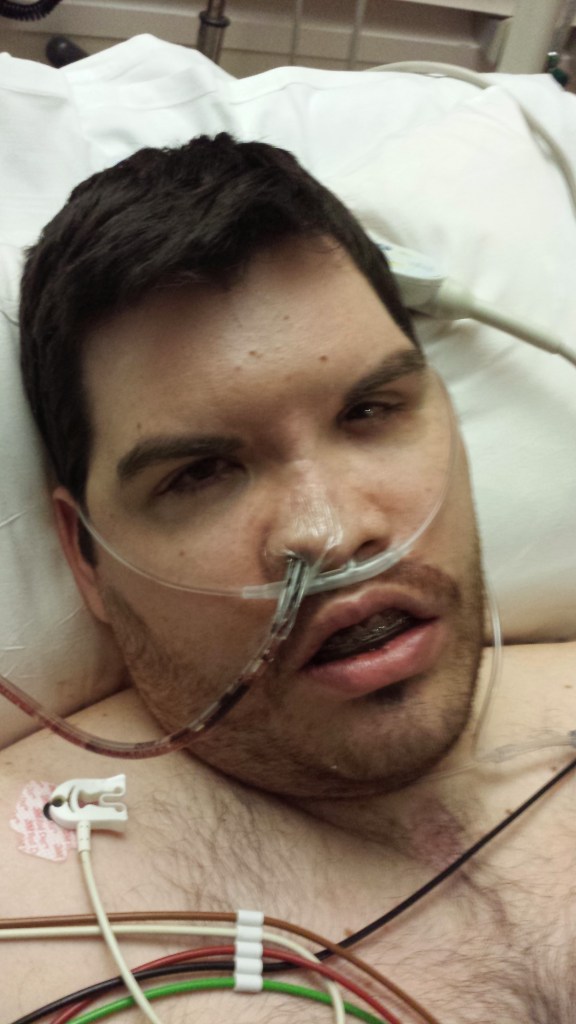
We’d been told that adults in particular sometimes struggle with this surgery and sometimes have to stay in the hospital for a week afterwards. They said kids tolerated the proceedure much better. Proving his Wolverine-like powers, Derek had the surgery and was discharged the next day. He was in the hospital only a day and a half. He was on a liquid diet once more, but lucky for us this time his mouth was only banded shut (instead of wired shut like before).

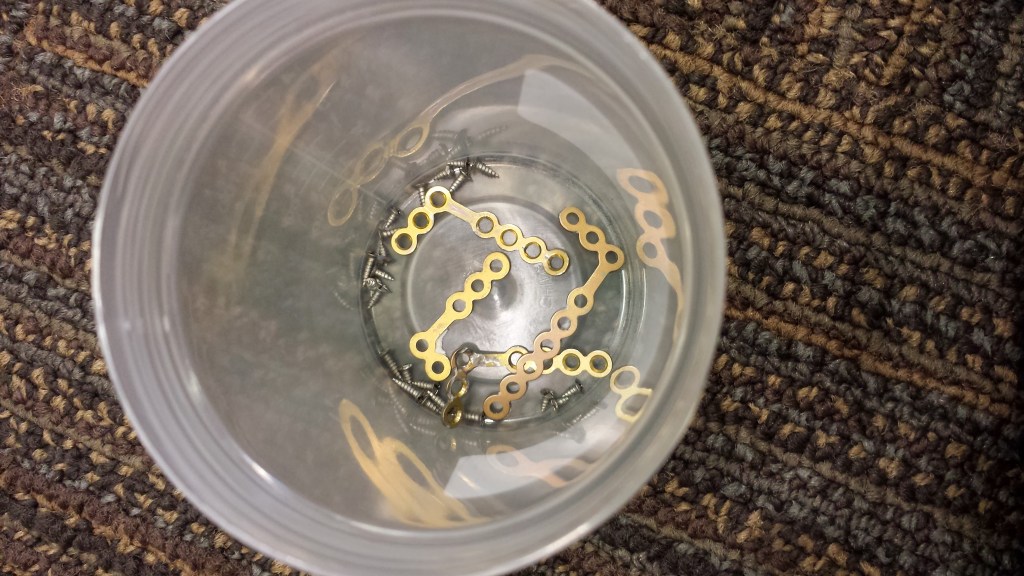
After Derek’s surgery, the doctor gave me the hardware they removed. He joked that I should make jewelry out of it–it would probably be the most expensive I owned. I made dangly screw earrings and a face plate necklace.
Derek had a small surgery in February 2014 to remove the splint that had been in his mouth to stabilize his upper jaw. Later that month, the pain he’d had at the beginning of January returned. His cheek swelled up like there was a golf ball in his cheek, and he was referred to an endodontic specialist because doctors were fairly sure that the hardware in his face had killed some of the roots of his teeth.
 Swelling from an infection from damaged teeth.
In April of 2014 when Derek had an opportunity to get new glasses, I insisted he do it. He was still taping his old ones to his face because his nose was so flat it couldn’t hold them up. He chose a new style that worked better with his new face. Derek felt a lot better about himself once he didn’t have to tape his glasses onto his face anymore. The new glasses rested more on his cheeks instead of the bridge of his nose.
I kept trying hard to have us work out, eat healthy, and improve. By September 2014 the doctors had decided that he’d healed enough for them to try to give his nose more projection and structure. In an outpatient procedure, they peeled his face off again, rebuilt the nose, and sent him home with me the same day.


It was about this time that Derek was starting to worry about money. Things were really uncertain. We didn’t know when or if he’d be able to go back to work. I got a part-time job, but it felt more like full-time because I was commuting an hour a day and working 4-5 times per week while still trying to take care of Derek and drive him to his appointments.
Sometime in 2015 he had another surgery, this one on his eyelids and tear ducts. The surgeons tweaked his eyelids so that they would close all the way when he blinked. They also created a new tear duct for him so that his eye could drain like it was supposed to. They placed a little tube in his eye that kept the tiny channel from scarring over and closing up.
My new job didn’t diminish any of the responsibilities I still had at home, it just reduced the time I had to do them by six hours per day. I still did all of the household chores (cuz Derek was never supposed to bend over and pick things up because of all the surgeries that just kept coming), the lawn and landscaping, meal planning, grocery shopping, weight management for myself and for Derek which was constantly being sabotaged by a barrage of surgeries and recoveries and muscle atrophy.
Derek had been getting medical massages to help him function and reduce his pain instead of using narcotics, but the insurance company was so far behind in paying them they wouldn’t let us book anymore without paying up front (which the insurance company didn’t want us to do because then they would end up paying more than they legally had to). I became Derek’s on-call massage therapist after that, a skill I learned as I went along. I massaged him daily. Sometimes he couldn’t get up and function without being massaged first. Sometimes he couldn’t sleep because of the pain. Sometimes he would wake up in the night from pain. When I started getting stiff and sore from massaging him so much, I told him we needed to invest in a massage chair. The chair may have saved my life. It did the hard labor, and I did the detail work on him.
At one point Derek finished his current round of physical therapy and we weren’t sure the doctors would prescribe more. They didn’t seem to be helping him move past his current plateau. I felt like they thought he was good–his legs both bent as far as they should, and he could walk. It was disheartening because he was so far from where he had been before the accident, and so far from where he wanted to be. He had developed compensation patterns and it was starting to show in his contorted posture, stiffening body, and odd gait.

You can see how contorted his body was becominng over time.
I didn’t know what to do. I scrambled trying to find what I even needed to learn to be able to help. I felt like there were like a thousand areas I needed to instantly be a professional. I was stuck in some weird time warp where everyone else was moving on with their lives, having families and pursuing careers, and here I was, a perpetual beginner who could never conquer any ground, stuck at home in a life that consisted of four walls.
Every time I graduated from one role, I had to take on another, working from the ground up with no experience, trying to become an instant expert in an endless set of fields–from trying to gain proficiency as an untrained nurse, to a pain management specialist, to a massage therapist, to a physical therapist, to a body mechanics specialist, to a personal trainer, to a sports therapist, to a nutritionist, to a life coach. Not only was I trying to acquire all of this knowledge, but I was trying to translate it into real-world experience and application instantly. I got a personal training certification and followed doctors, physical therapists, and massage therapists on Instagram. I constantly read books and articles.
I hadn’t accomplished any of the goals that I’d wanted to do in my life. I had wanted a family. I had wanted to write middle grade and YA books. I had wanted to be fit and hike and play and camp. I had wanted to have some kind of career. I knew what it looked like on the outside: Derek had been in an accident a few years ago, but now he was fine. He was just a little out of shape. No one had any idea the amount of effort I put in behind the scenes to get us to function at all. People told me they thought my life “was like a fairy tale.” Others weren’t shy in pointing out how few responsibilities I had–not even a job or kids. People asked me what I did all day. I was gaining weight every year. I was tired of people asking when we planned to have kids. I couldn’t manage anything else. I also hated it when anyone asked, “What do you do?” They always expected to hear about a job or kids and I didn’t have either.
In August of 2015, Derek got a new job. It seemed like it might be perfect. I was so happy for him, but I was worried too. Sometimes he had a hard time being upright long enough to go to church. He spent most of his day on the couch. How was he going to work eight hours a day? It might be okay, because as an Engineer, he would be at a desk, but I knew it was going to be hard. When he started working it was really hard. He’d get up really early before work and soak in the tub for a few hours before moving on to the massage chair for a 45 minute session. He’d go to work, and when he came home at night, he would sit in the massage chair for another session or two, and then go to bed. He usually needed me to work on him too. I worked at my job for about two months while he worked too before I decided I couldn’t do it and quit. Something had to go, and that something was my job. I’d had the job for less than a year when I quit again.
In 2017 I doubled down on trying to help Derek feel and move better. He had reached a point where he could do more in a day than just go to work and come home and sleep. I bought huge books about fasica, functional movement, athleticism, and preparing to run and read them cover to cover, taking notes. This time I started to follow body mechanics specialists, sports therapists, and neurokinetic therapists online. My Living Room was a makeshift physical therapy office. We had massage tools, straps, bands, props, and books.
It was frustrating when in December Derek started having pain in his face again. He went to the dentist and learned that one of the teeth that had been previously repaired had become infected again. When he went in for the appointment to fix it, the local anesthetic did nothing to his pain. The dentist said that clearly something more was going on that just the tooth, and said that we needed to figure that out before he could work on the tooth. Derek’s pain had been increasing everyday. I didn’t know how we’d manage it at home. We didn’t know which doctor to try to see, or how long it would take to be able to get in to see them. When we got home I broke out the narcotics from a previous surgery, but it didn’t even touch the pain. That was when I knew that this wasn’t something that we could manage on our own.
This time we skipped a step and went straight to the ER at the U of U. Unfortunately, the ER doctor assumed that we were either druggies or had the IQ of rocks. They didn’t want to CT scan him to look for anything wrong because we’d told them that he had an infected tooth and they thought that was the source of the pain. We knew it wasn’t. It was a new, different type of pain that we’d never dealt with before. They wanted to prescribe some narcotics and discharge him. I said no. I had drugs at home already. That wasn’t why we had come, and we weren’t leaving until they could tell me why he was in such extreme pain. We weren’t leaving until they at least tried to figure it out. When we refused to leave, the doctor consulted with some of Derek’s previous doctors there at the U of U.

At the ER, trying to figure out why Derek was in so much pain. After a CT scan, we learned he needed another surgery.
Turns out Derek’s neurosurgeon did think it was a good idea to CT scan him to see if anything was wrong. When they scanned him they found out that he had sinus opacification, which was a fancy way of saying that his sinus was filled up because it couldn’t drain. They would have done surgery the next day, but one of the medications they’d given him was a blood thinner so they scheduled it for a week later. After the doctor performed the surgery to fix his messed up anatomy, she told us with grossed out delight that he’d had tons of puss trapped in his face.
 Prepped for another surgery, markered on his face so they’d be sure to operate on the correct side.
In Feb 2018 The doctors decided that Derek’s tear duct had healed enough that they could remove the little tube in his eyelid that was keeping it open. It had been in there for about three years. Derek was really happy and felt like he’d made progress, but the problem with the infected tooth still needed to be addressed. We went to multiple specialist appointments and got their opinions. No one could guarantee that fixing the tooth again would keep the problem from coming back. If there was a microfracture in the tooth that they couldn’t see, the problem would keep coming back no matter how many times it was fixed. The other option was a dental implant.
A dental implant was a somewhat extensive and involved process. Derek would have to have the tooth pulled. They may or may not be able to place the implant at the same time, which was basically a metal screw that would go up into his bone. At subsequent appointments they would check to see if the implant was secured enough into his jawbone, and once it was, they would use a little connector thing to hook on a custom crown. The whole process would take months. Derek chose the implant option, because he didn’t want to run the risk of the infection coming back again.
I was still studying chronic pain and injury recovery. I was creating workout plans. I was trying to straighten Derek out when he came home from work all kinked up with angry muscles. I would try to massage out the asymmetries out of his body. My efforts felt futile because I didn’t know what I was doing, and although I could keep him going all week, he was always messed up by the weekend. We would work to straighten him out, and then the next week he’d go back to work and we’d start the cycle all over again.
The years of stress and repeated surgeries were adding up. We’d both gotten fatter. I tried to make us exercise, but he could barely do anything. Physical activity always made things worse. How do you work out, when moving is the problem? There was no way we could exercise the extra weight away. I tried to study diets, but the more I learned the more I realized the “healthy” diets contradicted each other. I didn’t know what to do. It didn’t help that he’d lost his sense of smell, and therefore the majority of his taste.
In the summer of 2019 things were going better. We got to go on a beautiful hike in the mountains near our home. We took one of our friends who was 75 years old at the time. We used walking sticks and hiked over boulders, criss-crossing over streams. It was a perfect day like a landscape painting come to life. Pine trees lined the trail and and butterflies fluttered among the wildflowers. It was also very hot. Derek never did well in the heat, and I wasn’t sure why. His body couldn’t seem to thermoregulate right. He did fine on the hike, but I tried to cut it shorter than I wanted it to be, for our friend’s sake and for Derek’s. Even though I had us turn back sooner than we wanted to, Derek still suffered for days afterward. This hike was a turning point in Derek’s recovery. At the time, it seemed like another low point
When we talked to our friend later, we learned he hadn’t even had to take ibuprofen. I was so frustrated. Was this really how things were going to be? Was Derek always going to be physically worse off now, despite all of our efforts, than a 75 year old man? None of the doctors seemed to have any insight or recomendations. I didn’t know who to ask, or what to learn about to try to make things better. Maybe this was just the way things were now.
That summer I started trying to build the life we wanted once more. Step one was to feel better. I started jogging. Derek joined me. We’d sort of tried running before, but he’d always hit walls of pain or fatigue. I had never been able to solve the problem of why exercise made him worse. We started slow like we always had, and for almost three weeks it worked. We ran every other day. He wasn’t even sore. Then the reckoning came. He crashed and burned hard. His body rebelled. He could barely walk. I knew it couldn’t be delayed onset muscle soreness because that was supposed to kick in within a day or two of your workout, not weeks later. How had he been fine for two weeks, only to be destroyed now?
I couldn’t figure it out. We both stopped running as I tried to straighten him out so that he could function again. His whole body hurt and he couldn’t even walk. I took him to a physical therapist I picked out because she had certifications in neurokinetic therapy. The people on instagram who fixed people whose posture was twisted like Derek’s were neurokinetic therapists. She started by working on his breathing, and told us about the importance of the nervous system. Propped up to facilitate breathing from the diaphragm to help relax the nervous system.
When we visited her another time I told her the laundry list of his weird, unrelated, and lingering symptoms. She recommended a book called The Magnesium Miracle, which I immediately bought and read. The book talked about the symptoms of mineral deficiency, the various causes, and what to do to fix it. I started supplementing both of us with minerals, especially magnesium. When we started doing that, things changed. This aspect of nutrition was the missing puzzle piece we needed. It was a miracle.
It was around this time that I discovered another missing piece in Derek’s recovery. I followed an account on Instagram with pictures of clients who were even more twisted up than Derek was. They had severe scoliosis and looked like they were in so much pain. The difference between their before and after pictures was inspiring. They went from twisted people who looked like they were in agony, to regular people with normal posture. I was in awe. This was what I needed. I didn’t know what the program was, but whatever they were doing was working. I wanted it and I needed it. When they offered a free trial for two weeks I siged up immediately. I remember watching the excercises in the program to see what they were and to decide if I thought Derek could do them. It was so gentle and it made sense. Posture Therapy was what I’d been searching for.
In September 2019, Derek had some weird health problems. His right eye, the one that hadn’t been damaged as much in the accident, developed an ulcer. He told me that he thought he had something in his eye, and when I looked at it there was a light cloudy spot. I told him he needed to go to the eye doctor as soon as possible because I knew that ulcers would rapidly deteriorate and cause loss of vision or blindness. He got that taken care of, but shortly after that he had additional problems.
Later that month, his left eye suddenly stopped tracking with his right eye. It was pointing off in it’s own direction. Though he didn’t have any speech or mobility problems, I knew that the loss of functioning in his eye was a neurological symptom and might be indicative of a stroke. We took him to the ER. The doctor was worried and wanted to CT scan right away to see if there were physical causes for what was happening. When he wasn’t able to find anything that way, he wanted to do an MRI and look for evidence of a stroke. Nothing showed up on the scan. The doctor laughed, baffled. He said that the symptoms were there in front of him, but that he had no explanation. He could tell us that Derek wasn’t having any life threatening problems and that he should be fine to go home and get some rest. He recommended we follow up with Derek’s specialist to see if they knew more than he did.
We weren’t able to get in to see the specialist for a few days. In the meantime, I patched Derek’s glasses so he wouldn’t get headaches from his tilted double vision and he rested at home. A few days later when we went to see the specialist, his symptoms had miraculously resolved, which perplexed the doctors even more. They too had no explanation for what happened, although they later said that because of the extent of Derek’s previous trauma, things like this might happen from time to time. As long as they weren’t accompanied by other worrisome neurological symptoms, we could assume that they weren’t a problem. We made another breakthrough because of this incident and discovered he has sleep apnea. After he got a sleep apnea machine, he started healing at an even more accelerated pace. He had more energy and felt better immediately.
When Covid-19 disrupted the world in 2020 I was devasted. We were so close to returning to normal, and then the whole world was upended. We worried about whether Derek was immunocompromised because of his weakened immune system. Even regular colds had hit him extra hard after his accident. Still, his immune system seemed to be working better now that we’d been supplementing him with liquid minerals and probiotics. Though we’ve been understandably concerned about the global pandemic, we’ve continued to work towards our goals of fitness, health, and strength.
Last summer, as I thought about the people who would be hospitalized from Covid-19, I saw our struggle in them. I worried that these people would return home from the hospital and face the same struggles that we did so many times. How do you recover from hospitalization? How do you regain atrophied muscle? What do you do when your body is so twisted up from pain and compensations that everything hurts? How do you return to normal life and the things that you love when you can’t function like you used to, when regular exercise leaves you worse off than before? What do you do when you have inexplicable symptoms that doctors don’t seem to understand, much less know how to fix? Where do you go to find the resources you need when you don’t have the words to describe what you’re looking for? I realized that we could be the resource that we needed, but didn’t have.
I believe the information we have can be life changing. I hope that we can collaborate with researchers and learn if that’s truly the case — and if it is, that we can get this information to the people who need it so that they can have a more complete recovery, too.


 Crash to Comeback